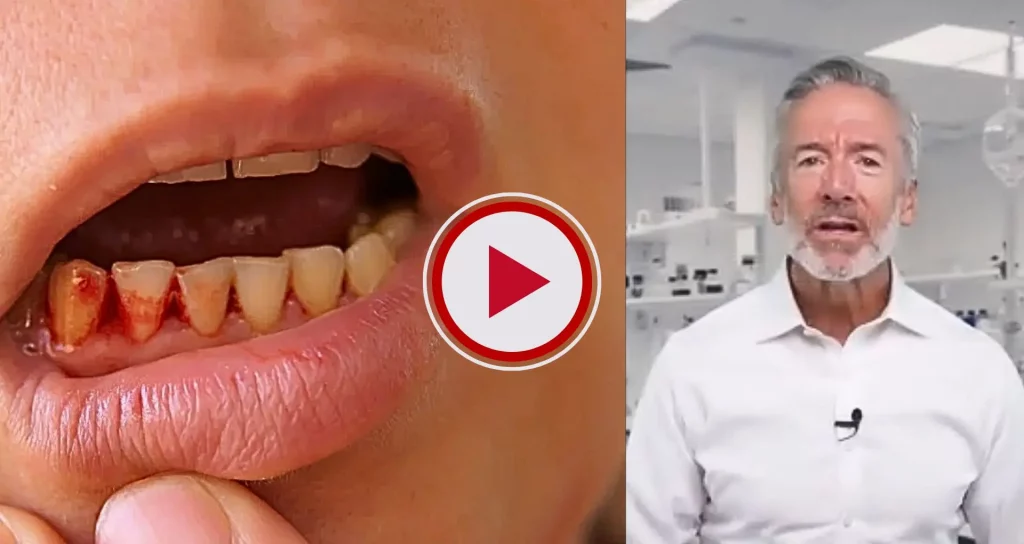
There’s something hidden inside your mouth that’s quietly
eating away at your smile every single day —
while you pretend everything is under control.
You feel it before you’re even fully aware of it.
You wake up with a weird taste.
You brush your teeth, trying to “fix it.”
But deep down… you know.
Nothing was fixed.
You talk while keeping your distance. You smile without showing your teeth. You avoid photos. You avoid getting too close.
And the worst part isn’t the smell. It’s the constant fear of being found out.
The step back. The avoided kiss. The restrained smile.
It all starts in the mouth — and ends with your confidence.

There’s a specific bacterial colony that:
— doesn’t die from strong mouthwash
— doesn’t go away with aggressive brushing
— actually learns how to survive the harder you try to fight it
It hides inside microscopic cracks in your teeth and gums.
At night, when your mouth dries out…
it multiplies.
Silently.
That’s why:
— the bleeding won’t stop
— bad breath keeps coming back
— your gums feel swollen and sensitive
— your mouth never truly feels clean
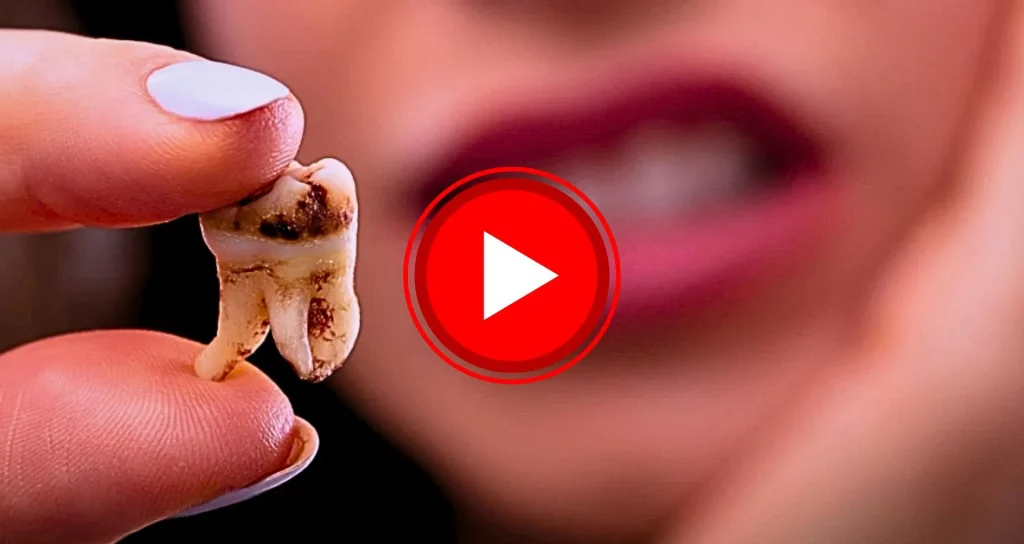
You were taught to attack the problem with force.
But force only creates scorched earth —
it wipes out your natural defenses
and leaves the door wide open for something worse.
It’s a cycle.
And the longer it goes on,
the harder it is to break.
Many people feel they were never truly taken seriously.
Not because they didn’t see dentists —
but because no one ever explained why this keeps happening.
The advice is always the same:
brush harder,
use stronger products,
come back for another deep cleaning.
But no one explains why the problem always returns.
That’s why interest is growing in research outside the traditional model.
Studies on the oral microbiome, regeneration, and biological balance are finally giving people hope.
“Just knowing someone is finally looking at this differently gives me hope.”
At the end of the day, the desires are simple:
— brushing without seeing blood
— talking without worrying about breath
— sleeping without discomfort
— smiling without fear
They’re not big asks.
But for someone who’s lived with this for years,
they would mean everything.
IMPORTANT
If you keep doing what you’ve always done,
you’ll keep getting the same results —
or worse.
This presentation explains exactly:
what’s really happening inside your mouth,
why common methods keep failing,
and what actually triggers real recovery.
It’s already been questioned and pressured for going against established practices.
It could be taken down at any time.

Scientific References
- Amaechi, B. T., Lemke, K. C., Saha, S., Luong, M. N., & Gelfond, J. (2021). Clinical efficacy of nanohydroxyapatite-containing toothpaste at relieving dentin hypersensitivity: An 8 weeks randomized control trial. BDJ Open, 7(23), 1–8. https://doi.org/10.1038/s41405-021-00080-7
- Bauer, J. A., Zámocká, M., Majtán, J., & Bauerová-Hlinková, V. (2022). Glucose oxidase, an enzyme "ferrari": Its structure, function, production and properties in the light of various industrial and biotechnological applications. Biomolecules, 12(3), 472. https://doi.org/10.3390/biom12030472
- Berlutti, F., Pilloni, A., Pietropaoli, M., Polimeni, A., & Valenti, P. (2012). Lactoferrin and oral diseases: Current status and perspective in periodontitis. Annali di Stomatologia, 2(3–4), 10–18.
- Chen, S. Y., Delacruz, J., Kim, Y., Kingston, R., Purvis, L., & Sharma, D. (2023). Effect of xylitol on Porphyromonas gingivalis: A systematic review. Clinical and Experimental Dental Research, 9(2), 265–275. https://doi.org/10.1002/cre2.724
- Ryder, M. I. (2020). Porphyromonas gingivalis and Alzheimer disease: Recent findings and potential therapies. Journal of Periodontology, 91(1), S45–S49. https://doi.org/10.1002/jper.20-0104
- Farooq, I., & Bugshan, A.